Moore Engineering opens Minot office to better serve northwest region


Moore Engineering CEO Jeff Volk cuts the ribbon to officially open the company’s new Minot location. Branch manager Brock Storrusten is currently looking to fill up to nine positions.

Moore Engineering opens Minot office to better serve northwest region
Moore Engineering isn’t new to the Minot area. We do work in communities like Harvey, Watford City, Tioga and others. We’ve completed projects in Minot and we serve on the Souris/Mouse River Study team. But with a new location in Minot, we’re expanding our ability to serve clients in that part of the state with municipal, transportation, environmental, water resource, GIS and land surveying projects.

It’s the next step for us in helping people in and around the Minot area deal with the significant challenges associated with water and infrastructure issues. Brock Storrusten, PE, a 17-year veteran with the company who served as assistant city engineer for West Fargo during that city’s growth and expansion, will be managing the Minot office. Hiring is underway, with job openings as we add engineers, survey crew and other personnel.

We’re excited to bring our additional resources, expertise and experience to help the northwest area build and rebuild. Moore Engineering is a company with a 50-year-plus history of growing along side our clients—adding services and staff to help them deal with everything from natural disasters to rapid growth to the many issues associated with simply maintaining strong, safe and healthy communities. Some of what we’ll bring to Minot:

  •  Experience in municipal and water resources
  • Knowledge of how to develop funding sources in both pubic and private sectors
  • Ability to bring people and resources together, identifying all the resources needed to make a project successful
  • A client-centered philosophy, resulting in decades-long relationships

Moore has a history of growing along with clients
As the longtime city engineer for West Fargo, we were instrumental in planning and implementing the Sheyenne Diversion project that protects West Fargo from flooding and continues to play an integral role in developing, building and managing the region’s water resources. It’s also a city that has experienced rapid growth. We are currently expanding our headquarters there—adding some 8,000 square feet to total about 30,000—and have added transportation and environmental divisions, while growing our GIS division. The expansion will add 34 new offices and additional meeting space.

We believe Moore Engineering and Minot are a great fit and we’re here to stay. Community involvement wherever we do business has been a company hallmark since we opened our doors. Just one example, each year we pick a charity and raise money for it during our Christmas party. This year, it was clear Minot was in need so we asked our employees to think about doing a little extra and the company committed to matching every dollar. Employees donated just under $8,000 so the next morning Moore Engineering sent $16,000 to the Minot Area Community Foundation to help flooded residents restore and rebuild their homes.

As Minot and the region continue to recover from the flood and meet the challenges of growth spurred by a booming energy industry, Moore Engineering will be there to help.

Interested in applying in Minot?
Browse openings on our website, email Joni Smith in human resources at jsmith@mooreengineeringinc.com, or call Brock in the Minot office at 839-1590.

Posted in Client Service, Flood, Minot, Moore Engineering, Municipal, Small Cities Development, Surveying, Transportation, Water Resources | Tagged , , , , , , , , | Leave a comment

Partners in creating safe routes to school

School is back in session for another year and parents want to make sure their kids have a safe and healthy way to get there. At Moore Engineering, we’ve been working with communities to do just that—through the Safe Routes to School program.

Safe Routes to School is a federal program that encourages children to walk and bicycle to school by making doing so safer, healthier and more fun. Communities improve infrastructure and plan projects and activities that help their kids socialize with friends, learn about their neighborhoods, gain a sense of independence, and foster healthy habits that could last a lifetime.

 Here are the Safe Routes program goals:

  • Increase bicycle, pedestrian and traffic safety.
  • Encourage a healthy and active lifestyle and reducing childhood obesity.
  • Improve community safety, security, accessibility and community involvement.
  • Improvements to the physical environment that increase the ability to promote more children walking and bicycling to and from schools.
  • Decreased traffic congestion and fuel consumption and improve air quality.
  • Improve partnerships among schools, local communities, parents, and other community groups, including non-profit organizations.
  • Increased interest in bicycle and pedestrian accommodations throughout the community.

Steps to creating safe routes to school
Moore Engineering helps communities every step of the way in creating safe routes to school and achieving program goals. We put our expertise to work beginning with planning and preparing the Funding Applications and continuing through the planning, design and construction phases.

Selected projects will have eligible construction improvements paid up to the amount of the awarded funding. Improvements include sidewalk, installation of ADA ramps, traffic calming, bicycle and pedestrian crossing lights, stripes and signs. Improvements also include new or upgraded on-street bicycle lanes, multi-use bicycle and pedestrian trails and pathways, along with other safety and convenience measures.

How do your kids get to school?
Do they take safe and healthy routes? Have you had any experience with the SRTS program or other community efforts to help kids get safely to and from school? We’d like to hear from you.

To find out more about the Safe Routes to School program or for help in completing the program applications, please feel free to contact David Roedel  in our office.

Posted in Client Service, Safe Routes to School, Safety, Transportation | Tagged , , , , , | Leave a comment

Moore Engineering expanding West Fargo headquarters

One year after celebrating its 50th anniversary, Moore Engineering, Inc. (MEI), announced a plan to expand the civil engineering firm’s headquarters in West Fargo to accommodate both current and future growth. The 8,000 square foot addition will bring the total space to more than 30,000 square feet and provide necessary office and meeting space for the firm.

“We have to thank our customers for the need to expand,” said Jeff Volk, president and CEO of the employee-owned company. “This new space is necessary to continue to be responsive to our client base – many who have been with us for decades. We continue to grow by holding our client-centered philosophies true.”

MEI has experienced more than 30 percent growth since the current building was built in 2008, with space designed to house a total of 72 employees- engineers to the support staff necessary to provide civil engineering service to small cities and communities- as well as advancing municipal infrastructures and serving watersheds, associations and other entities through water resource and transportation projects. MEI has completed more than 15,000 projects in Minnesota and North Dakota.

“We’re matching services to client needs,” added Volk, “so two new divisions, environmental and transportation have been created and our GIS division continues to grow, and that growth creates additional jobs and space needs to service our clients.”

The additional space will create private offices for 34 staff, 10 of which are already onboard, as well as conference and meeting space. The new addition will be added to the north of the existing structure and parking for an additional 65 vehicles will be added to the south. Construction is planned to be complete in late spring of 2012, prior to the firm’s busy summer season.

MEI (www.mooreengineeringinc.com) has headquartered in West Fargo, N.D., since 1964 and also maintains a branch office in Fergus Falls, Minn., to better serve Minnesota-based clients.

Posted in Client Service, Moore Engineering, Small Cities Development, Transportation | Tagged , , , , , , | Leave a comment

Deadlines nearing to apply for Minnesota’s Small Cities Development Program and Business Development Public Infrastructure Programs

Deadlines are approaching for submissions to Minnesota’s Small Cities Development and Business Development Public Infrastructure Programs for state fiscal year 2012.

The Small Cities Development Program (SCDP) helps cities and counties with funding for housing, infrastructure and commercial rehabilitation projects that benefit people of low and moderate incomes. Cities with fewer than 50,000 residents and counties with fewer than 200,000 residents are eligible.

The Business Development Public Infrastructure Programs include the Greater MN Business Development Infrastructure Program and the Innovative Business Development Public Infrastructure Program.

The Greater Minnesota Business Development Infrastructure Grant Program helps stimulate new economic development, create new jobs and retains existing jobs through investments in public infrastructure. It provides grants to cities of up to 50 percent of the capital costs of the public infrastructure necessary to expand or retain jobs in the area, increase the tax base, or expand or create new economic development.

The Innovative Business Development Public Infrastructure (BDPI) Program focuses on job creation and retention through the growth of new innovative businesses and organizations. The program provides grants to local governmental units on a competitive basis statewide for up to 50 percent of the capital cost of the public infrastructure necessary to expand or retain jobs.

Deadlines are as follows:

  • Pre-Short Form Application to SCDP: November 17, 2011, or before
  • Final Application to SCDP: April 12, 2012, or before
  • For the Business Development Public Infrastructure Programs, the MN Department of Employment and Economic Development (DEED) shall accept applications on an open application, (pipeline) basis until all funds are committed.

Contact should be made through the regional representative of the MN Department of Employment and Economic Development (DEED) for information and eligibility of projects for these funding programs.

For additional information about these programs and assistance in completing these applications, please feel free to contact Hugh Veit in our office.

Posted in Minnesota Funding, Moore Engineering, Small Cities Development | Tagged , , , , , , , , , , | Leave a comment

Moore Engineering’s Longest Serving Employee Retires

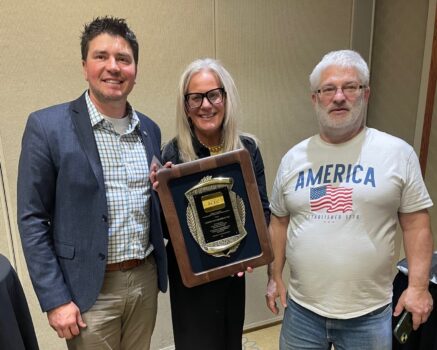
Carol Wendt, administrative assistant in the West Fargo Building Department, retired this year after more than 41 years with Moore Engineering. At a recent company ceremony, she was recognized for her many years of outstanding service.

After moving to the Fargo-Moorhead/West Fargoarea during the cold winter of 1969, Carol Wendt was hired February 23, 1970, as secretary, bookkeeper and general Jill-of-all-trades. Interviewed by the company’s two founding brothers, Kip and Marshall Moore, she eventually worked in nearly every aspect at the office.

Carol was a powerful asset to her coworkers for years, working seven days a week during the busy summer construction season, overseeing invoicing and payroll, typing and checking all plans, spec sheets, plats, and legal descriptions — all in addition to answering phones and keeping clients happy.

Carol stayed with Moore Engineering for more than four decades for a number of reasons — the company’s to-notch benefit package, the good people, the family-oriented atmosphere and the flexibility offered to employees. But really, she says, she was never bored, and that may be the #1 reason.

Things slowly changed over the years. The company purchased its first Xerox machine— and because the concept was so new, Carol had to receive special training in its operation. She planned the first and many following Christmas parties for the employees. She moved with the office from location to location, with her favorite office building – this one!

Of course, not everything has changed for the better over the years. Carol reports that the coffee was better back in the day – when she made it herself.

Posted in Moore Engineering | Tagged , , , , | Leave a comment

How do I make my neighborhood safer?

A safe neighborhood is important to everyone who lives in a community. What can be done to improve street safety for pedestrians and non-motorists, and create a more enjoyable and livable environment? Physical and operational features can be added to the roadway to improve the safety of streets and sidewalks.

Here’s our list of the top 6 things a community can do to make the neighborhood safer:

  • Add speed humps and raised intersections to slow traffic by as much as 10 miles per hour.
  • Narrow the width of the road, causing traffic to pay attention more to the surroundings.
  • Construct roundabouts.
  • Add curves to the road.
  • Add visible landscape features.
  • Add street signing and speed notification cameras.


Making neighborhoods safer, easier to navigate, and more livable for residents is just one of the things we do at Moore Engineering to improve the quality of life

Additional information on traffic safety can be found at the following website: http://trafficcalming.org/


Posted in Moore Engineering, Safety, Street and Sidewalks, Transportation | Tagged , , , , , , | Leave a comment

GPS is efficient, high tech time saver for Moore Engineering clients

The explosion of survey-grade GPS products within the past twelve years is no accident. The hardware is increasingly precise, the software user-friendly, and the customer service is consistently top notch.

Moore Engineering Inc, first tested GPS hardware in late summer 1999, where we proved its accuracy to less than a ¼ inch in a mile – astounding performance, especially for the efficiency provided. By testing the hardware against a previous large-scale project – the West Fargo Sheyenne Diversion – we became confident it could help our business continue to expand. Today, each of our survey chiefs operates a GPS rover in the field, a distinct time saver for our employees, contractors, and clients.

Through our work with the City of West Fargo, our Survey Party Chiefs have made extensive use of Trimble GPS hardware. Today, we are proud to say that each Survey Chief has more than four years experience with the technology, and we’ve put that experience to work throughout many of our projects throughout North Dakota and Minnesota. Our preliminary and topographic surveys are more efficient with GPS, dramatically decreasing the cost to our clients. We are able to complete construction staking in far less time – making construction crews happier. And we’ve made it easy to gather true latitude and longitude values, which means we can communicate that information to our airport clients more quickly, while fully satisfying federal regulations.

The following are some projects where we have used GPS:


The use of GPS directly increases the speed at which we can help our clients complete projects accurately and on-schedule, while being fun to use! Our crew chiefs continue to marvel at what GPS helps us achieve.

Do you have any experience working with GPS products? Can you share any examples of how this technology helps you achieve business objectives? We’d like to hear from you.

Posted in Client Service, Moore Engineering, Survey, Surveying | Tagged , , , , , , , , | Leave a comment

Fargo-Moorhead Diversion: why we need it

Why is a diversion necessary for Fargo-Moorhead? The simple answer is there is too much water that comes our way, and the only way to beat the biggest floods is with a diversion channel. Because the community has determined that protection from floods up to a 500-year level is necessary, the only way to provide that level of protection is with a diversion channel. 

Spring flooding from the Red River in the Fargo-Moorhead area has become a critical issue to the economic viability of the region. The Fargo-Moorhead Metropolitan Feasibility Study has been initiated with the objective to reduce this flooding risk. Moore Engineering, Inc. has been working hard to help ensure that the best and most complete plan is carried forward. We are utilizing our expertise in the water resources field to help this potential $1.5 billion project become a reality.

There are currently two alternative alignments considered for the Red River Diversion.  One is in Minnesota and is referred to as the Federally Comparable Plan (FCP). The other is in North Dakota and is referred to as the Locally Preferred Plan (LPP). These diversion alternatives each provide significant protection for large flood events, which reduces the risk for loss of life and property damages associated with a catastrophic flood.

Updates to the diversion analysis are currently being analyzed, so stay tuned for developments.

General background information along with updates to the project can be found at either the International Water Institute or the US Army Corps of Engineers St. Paul District websites.

Posted in Fargo-Moorhead Diversion, Feasibility Study, Flood, Moore Engineering, Spring Flooding, Water Resources | Tagged , , , , , , , , , | Leave a comment

What you need to know about spring flooding

After another tough North Dakota winter, people are looking forward to green grasses, productive crops, and throwing some steaks on the grill. But before we get to this point, there is one obstacle we must get through: the spring flood!

Spring flooding in the Red River Valley has become an annual concern, especially in the Fargo-Moorhead area. With the record floods of 1997 and 2009, people are taking no chances. Fargo alone will have 3 million sandbags ready for the 2011 flood. Here is what you need to know when it comes to spring flooding in our area.

  1. We had another wet fall, which fills depressions and potholes throughout the area.
  2. The ground is frozen, which makes more water runoff into the rivers.
  3. We have had 82.1 inches of snow so far this winter. The average is 46.7 inches.
  4. Additional snowfall in March and possibly April will worsen the flood situation.
  5. Large rainfall events (like in 2009) can have a dramatic impact on the severity of flooding.


The National Weather Service is issuing flooding outlooks every two weeks, and can be found at http://water.weather.gov/ahps2/index.php?wfo=fgf. Once the spring melt has begun, more accurate predictions on how high rivers will get will be issued by the National Weather Service. Another resource tool for flooding information is the Fargo Forum, which has organized various flooding subjects on its website at http://www.inforum.com.

Posted in Flood, Moore Engineering, Spring Flooding, Water Resources | Tagged , , , , , , | Leave a comment

Deadlines Nearing to Apply for Minnesota Water Projects

Deadlines are approaching for submissions to Minnesota’s Clean Water and Drinking Water Revolving Fund loan programs for state fiscal year 2012.

These programs offer below-market rate loans, principal forgiveness, or grants to local governments for eligible projects based on priority. Submissions are required for acceptance for placement of any public wastewater, stormwater, and drinking water infrastructure project on the 2012 Project Priority Lists (PPL) and Intended Use Plans (IUP).

Deadlines are as follows:

  • Wastewater Facility Plans or Stormwater Project Plans: March 4th or before
  • Request for Placement on PPL to the MPCA: March 4th or before
  • Request for Placement on PPL to the MDH: May 6th or before
  • Request for Placement on IUP to the PFA: June 3rd or before


Contact should be made through the MN Pollution Control Agency for any Clean Water (wastewater/stormwater) Project Priority List project, the MN Department of Health for any Drinking Water Project Priority List project, and the MN Public Facilities Authority (2012 Intended Use Plans) for both types of projects.

Additionally, these programs may require that a portion of the funding be reserved for “green” infrastructure through the Green Project Reserve (GPR) for both the MN Pollution Control Agency and MN Department of Health. Projects that may meet the eligibility for GPR should indicate so in their applications.

For assistance in completing these applications, please feel free to contact Hugh Veit of our office.

Posted in Water and Waste Water, Funding | Tagged , , , , , | Leave a comment